


.svg)

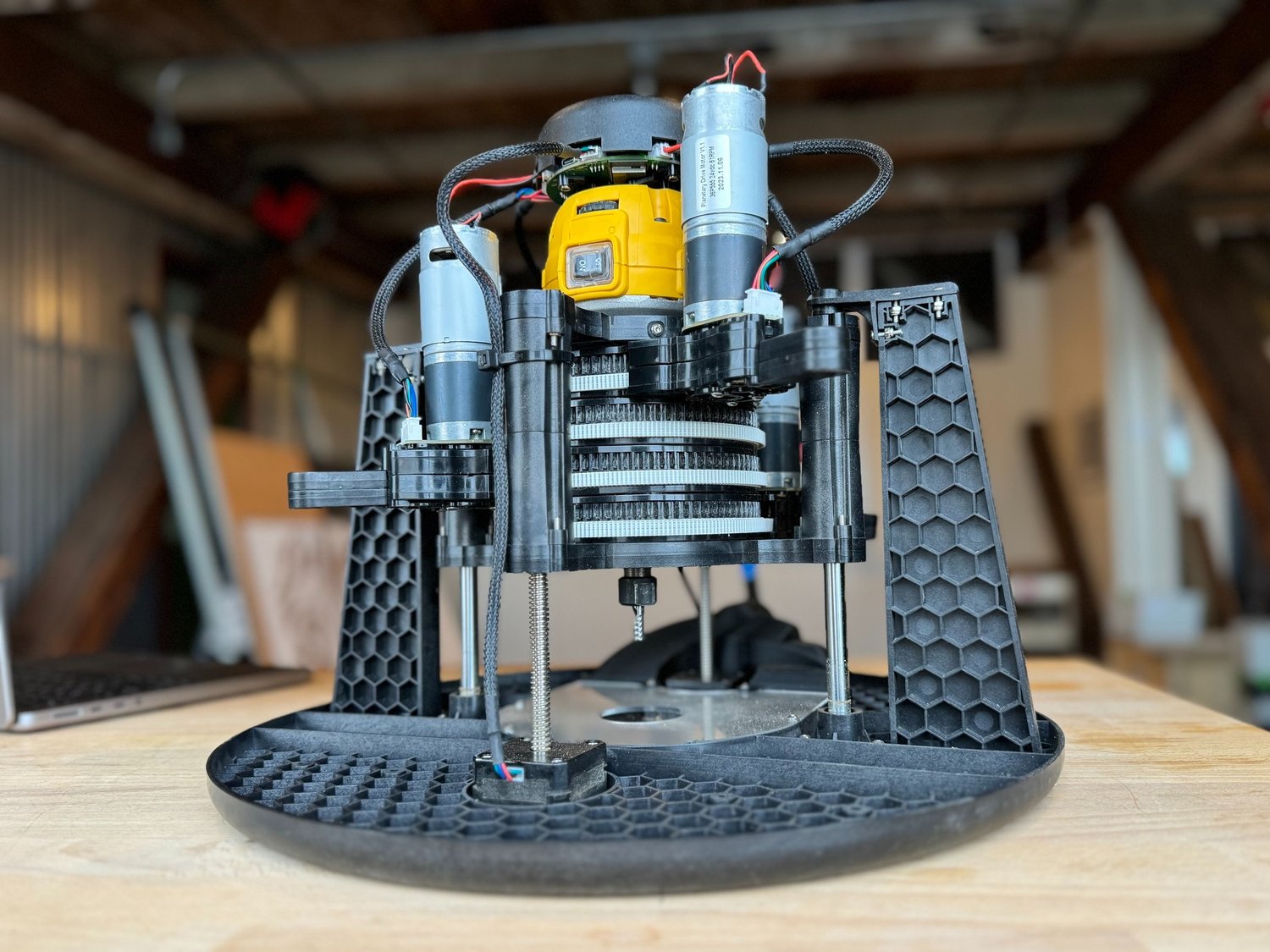
The Maslow 4.1 is a 1.2 x 2.4 meter (4 x 8 foot) x/y work area kit with 65mm (2.6in) of z travel. Four independently controlled steel-reinforced belts, each driven by a 24 volt DC servo motor through a planetary gearbox, move the sled up to 2,500mm/min (100ipm) in x/y and 300mm/min (11ipm) in z, while two lead-screw stepper motors handle the z-axis's 50mm (1.9in) of travel. The kit includes everything needed to cut except a Dewalt DW611 router (or D26200 for 240 volt).
Every cut starts with one formula: Feed Rate = Spindle Speed (RPM) x Chip Load x Number of Cutting Edges (flutes). Chip load is the thickness of material each cutting edge removes in one revolution of the bit. This number comes from the manufacturer of the bit, which publishes a chip-load chart for each bit diameter and material. Look up your exact bit and material, start from the middle of the published range, and you have the third number in the formula. The chart below shows the recommended spindle speed for each material and bit type.
Maslow does not publish a spindle RPM for the Maslow 4.1 since you supply your own router (a Dewalt DW611 or D26200), so check the plate on yours before you start. The 4.1's frame is a belt-driven sled steered by four DC servo motors rather than a rigid gantry, and it caps its own feed rate at 2,500mm/min (100ipm) in x/y and 300mm/min (11ipm) in z, so those numbers are hard ceilings no matter what the chip-load math says. A truly rigid, powerful setup can cut as deep as the bit is wide in a single pass, but that takes real spindle torque, a drive train and clamps that hold firm, a frame that will not flex, and enough mass to soak up vibration. The belt-driven Maslow 4.1 falls short of that bar, so take shallow passes. Push too deep and the bit deflects and chatters, leaving scalloped edges, or it rubs instead of cutting and burns the material. The fastest way to dial in a cut is to see what has already worked for other people.
Worked example for feed rate: 1/8in (3.175mm) two-flute solid carbide end mill in hard wood. The chart says 16,000 RPM. Maslow does not state a spindle RPM for the Maslow 4.1 since you supply your own router, so check the plate on yours and use its actual top speed in place of 16,000 if it is lower. With the bit maker's 0.025mm per tooth (0.0010 in): 16,000 x 0.025 x 2 = 800 mm/min (31 in/min) feed, but the Maslow 4.1 itself caps x/y feed at 2,500mm/min (100ipm), so stay under that regardless. For depth per pass, start shallow and check Community Cut Settings in Easel for what works on this machine. If the cut sounds strained, reduce the depth, not the feed. Slowing the feed below the chip load makes the bit rub instead of cut.
Community Cut Settings shows the spindle speed, feed rate, and depth per pass other makers actually run for your machine, material, and bit.
Maslow states the Maslow 4.1 works from standard GRBL g-code files (.gcode, .nc), but that describes the file format, not a confirmed GRBL firmware or controller name for its own belt-driven servo system. Easel's real-time carving works with GRBL controllers over USB, so a human needs to confirm exactly how this machine's controller talks to Easel before publish. It is selectable in Easel's machine menu as Maslow 4, which sizes the canvas to its 1.2 x 2.4 meter (4 x 8 foot) work area.
Try Easel Free →
Create your free Easel account and connect your machine in minutes.
Easel Free Trial →